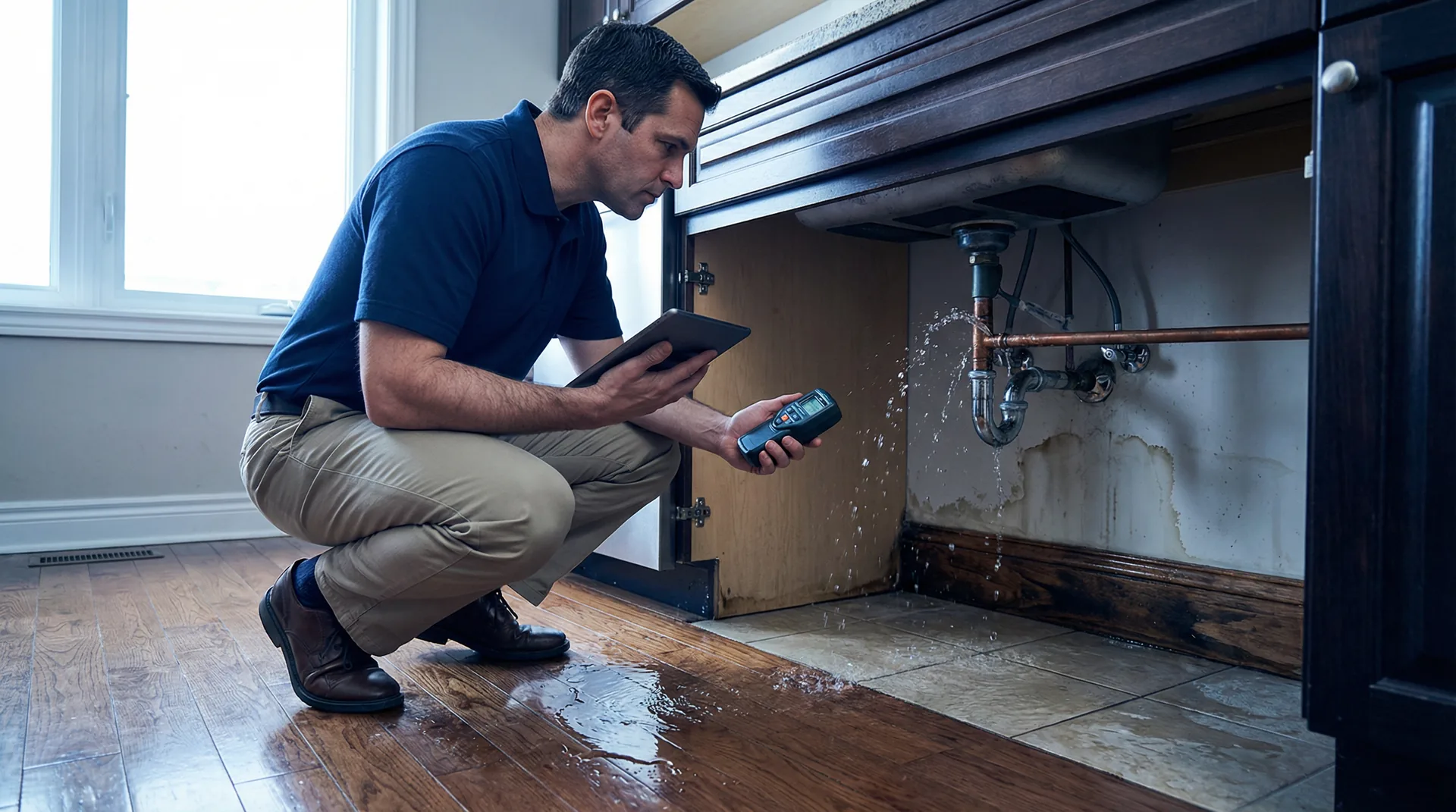
Important: Call a Public Adjuster When You Call Your Mitigation Company
After a plumbing failure, professional mitigation is essential to prevent mold and further damage. However, if the insurer classifies the damage as gradual rather than sudden, coverage can be denied , leaving you responsible for the mitigation bill.
Call DCS at the same time you call your mitigation company. We document the cause and timeline of the plumbing failure, review your policy, and confirm coverage while the mitigation team begins emergency drying. This protects your claim from the start.
Sudden Plumbing Failures Are Covered. Gradual Leaks Are Not. We Know the Difference.
Homeowner insurance covers sudden and accidental plumbing failures. A pipe that bursts, a supply line that fails, or a fitting that gives way unexpectedly is a covered loss. A pipe that has been slowly leaking for months, causing gradual damage to the surrounding structure, is typically excluded under the gradual damage exclusion.
The challenge is that insurance companies sometimes classify sudden failures as gradual to deny or limit claims. We investigate the plumbing failure, document the cause and timeline, and build the evidentiary record that establishes whether the damage was sudden and accidental.
Supply Line Failures: Burst or failed water supply lines to toilets, sinks, dishwashers, and refrigerators
Pipe Failures: Burst pipes, failed fittings, and corroded pipe sections that release water suddenly
Appliance Connection Failures: Failed connections to washing machines, dishwashers, and ice makers
Water Heater Failures: Tank ruptures, failed pressure relief valves, and connection failures on water heaters
Structural and Interior Damage: Flooring, drywall, cabinetry, and structural components damaged by the plumbing failure
Mold Risk: Mold growth resulting from water that was not discovered and dried promptly
Houston, Texas
Plumbing Leak Claims in Houston
Plumbing leak claims are among the most mis-handled losses in the Houston market. Carriers routinely deny them outright on wear-and-tear grounds, or pay only the visible drywall without addressing the subfloor, wall cavity, cabinetry, and mold remediation. DCS has reversed multiple Houston plumbing denials to full policy-limit settlements.
Recent Houston-Area Events That Drive These Claims
Toilet Supply Line Failures
Year-round
A failed toilet supply line on a Conroe home with Liberty Mutual coverage settled for over $130,000 after DCS was engaged from day one and properly documented subflooring, cabinet, and structural framing damage.
Kitchen Sink Overflow Events
Year-round
Sudden overflow events — including a Lumberton-area Berkshire Hathaway claim that went from $11,344 to $93,980 under DCS representation — are frequently underpaid on the initial inspection because the full extent of cabinet and subfloor damage is hidden.
Denied Plumbing Claims
Year-round
A Houston homeowner on Allstate was denied her plumbing leak claim in full. DCS reversed the denial and negotiated a policy-limits settlement after assembling engineering causation evidence and citing Texas bad-faith statutes.
Houston-Area Rules and Local Notes
Under most Texas HO-3 policies, plumbing leaks are covered if the cause of loss is sudden and accidental. Long-term leaks are excluded — so the causation investigation is everything. Most denials can be reversed with proper engineering documentation.
Houston slab leaks often involve access-and-repair endorsements. Whether the carrier owes the cost of breaking and restoring the slab is a commonly disputed coverage question we address with policy language and forensic plumbing reports.
Supply-line failures within the first 10 years of a build are often traced to manufacturing defects. DCS coordinates with forensic plumbers to preserve the failed component for the subrogation process.
Houston-Area Case Results
Rick & Jeanne — Conroe, TX
Liberty Mutual2024
Toilet supply line failure
Initial
DCS engaged from day 1
→
Final
$130,000+
A toilet supply line failure caused catastrophic water intrusion across multiple levels of the home. DCS documented the full scope from day one, including subflooring, cabinetry, and framing. Liberty Mutual settled at over $130,000.
Mona — Houston, TX
Allstate2024
Plumbing leak — initially denied
Initial
Denial letter
→
Final
Policy limits
Allstate denied Mona's plumbing leak claim in full. DCS assembled engineering causation evidence, built the bad-faith and prompt-payment file, and negotiated a full reversal. Final settlement was at the policy limit.
JO
Reviewed by Josh Osteen
Founder & Licensed Public Adjuster
Josh Osteen founded Dependable Claims Specialists after seven years as an insurance carrier field adjuster and team lead (2010–2017). He has represented Houston-area policyholders exclusively since 2017 and has handled every major Gulf Coast catastrophe from Harvey through Hurricane Beryl.
Texas PA License #2237777Florida PA License #W045717
Know Your Peril
Why Plumbing Systems Fail: Common Causes and What They Mean for Your Claim
Understanding why plumbing systems fail helps establish whether a failure was sudden and accidental or the result of gradual deterioration. This distinction is critical to coverage.
5-8 years
Braided Hose Life
Typical lifespan of braided stainless supply lines
3-5 years
Rubber Hose Life
Typical lifespan of rubber washing machine hoses
40-80 psi
Water Pressure
Normal residential water pressure range
High
Polybutylene Risk
Polybutylene pipes (1978-1995) prone to sudden failure
Plumbing failures occur for a variety of reasons. Supply lines to toilets and sinks are under constant water pressure and can fail suddenly when the braided or rubber hose deteriorates. Washing machine hoses are a particularly common source of catastrophic water losses because they are under full water pressure and can release large volumes of water quickly when they fail.
Polybutylene pipes, which were commonly installed in homes built between 1978 and 1995, are known to be prone to sudden failure due to reactions with oxidants in public water supplies. If your home was built during this period, it may have polybutylene pipes. These pipes can fail suddenly without warning, and the resulting damage is covered as a sudden and accidental loss.
The gradual damage exclusion applies to damage that occurs over time from a slow, ongoing leak. Signs of gradual damage include water staining that has been present for an extended period, mold growth that indicates prolonged moisture exposure, and deterioration of materials consistent with long-term water exposure. However, the presence of these signs does not automatically mean the damage is excluded. The key question is whether the policyholder knew or should have known about the leak.
Common ways plumbing leak claims are minimized include classifying sudden failures as gradual, arguing that the homeowner should have known about the leak, limiting the scope to only the visible wet area rather than the full extent of water migration, and excluding the cost of accessing the failed pipe (such as opening walls or floors). We address each of these arguments with documentation and expertise.
What You Need to Know
The Gradual Damage Exclusion
The gradual damage exclusion is the most common basis for denying plumbing leak claims. It applies when damage occurs over time from a slow, ongoing leak that the homeowner knew or should have known about. However, the exclusion does not apply to sudden failures, and many sudden failures are incorrectly classified as gradual. We document the cause and timeline of the failure to challenge improper exclusion applications.
Access and Tear-Out Coverage
When a plumbing failure occurs inside a wall, floor, or ceiling, the cost of opening the structure to access the failed pipe is typically covered under your homeowner policy. This is sometimes called access coverage or tear-out coverage. We ensure this coverage is included in your claim.
The Pipe Itself Is Not Covered
Most homeowner policies cover the damage caused by the plumbing failure but not the cost of repairing or replacing the failed pipe itself. The pipe is considered a maintenance item. We ensure the claim is structured to maximize coverage for the resulting damage while accurately representing what the policy does and does not cover.
Helpful Hints
Tips That Protect Your Claim
Shut Off the Water Immediately
Find and close the water supply to the affected fixture or the main water supply to stop the flow of water.
Document Before Any Cleanup
Photograph all wet surfaces, water lines, and damaged materials before any drying or cleanup begins.
Do Not Discard Damaged Materials
Do not remove and discard wet drywall, flooring, or cabinets until the insurance adjuster has inspected.
Save the Failed Pipe or Fitting
If the failed pipe or fitting is removed by a plumber, save it. The failed component is evidence of the cause of the loss.
Report Promptly
Report the claim to your insurer as soon as you discover the damage. Delayed reporting can complicate your claim.
Contact DCS PIA Before the Adjuster Arrives
We will document the cause of the failure and the full extent of water migration to establish coverage and maximize your claim.
Prevention
How to Reduce Your Risk
1
Replace rubber washing machine hoses with braided stainless steel hoses every 5 years.
2
Inspect supply lines to toilets, sinks, and appliances annually and replace any that show signs of corrosion, bulging, or deterioration.
3
Install water leak detectors under sinks, near appliances, and around the water heater.
4
Know where your main water shutoff valve is and make sure every adult in the household can operate it quickly.
5
Have your plumbing inspected if your home was built between 1978 and 1995 to check for polybutylene pipes.
6
Maintain water pressure within the normal range of 40-80 psi. Excessive pressure accelerates wear on supply lines and fittings.
7
Inspect your water heater annually and replace it proactively before it fails, typically every 8-12 years.
8
Consider a whole-house automatic water shutoff system that detects leaks and closes the main supply valve.
!
Critical: Protect Your Claim Before Starting Any Repairs
Do not begin full repairs until your claim is fully settled. Damage is evidence. Altering or removing it before your insurer has properly documented it can eliminate coverage entirely. Insurance companies only pay for what can be proven. Only perform emergency repairs necessary to prevent further damage, and document everything with photos and video before touching anything.
After the Loss
What to Do Right Now
1
Shut Off the Water Supply
Close the water supply to the affected fixture or the main supply to stop the flow of water.
2
Document Before Any Cleanup
Photograph all wet surfaces, water lines, and damaged materials before touching anything.
3
Save the Failed Component
Ask the plumber to save the failed pipe, fitting, or supply line. This is evidence of the cause of the loss.
4
Call a Licensed Water Mitigation Company
Professional drying equipment is essential to prevent mold. Ask for daily moisture logs.
5
Report the Claim to Your Insurer
Notify your insurance company promptly. Obtain the claim number and adjuster name.
6
Contact DCS PIA Before the Adjuster Arrives
We will document the cause of the failure and the full extent of water migration.
7
Do Not Accept a Settlement Without Review
Plumbing leak claims are frequently denied or limited. Review any settlement offer or denial with us before accepting.
Why Representation Matters
Only a Fool Represents Themselves
Plumbing leak claims are frequently denied under the gradual damage exclusion, even when the failure was sudden and accidental. Establishing the cause and timeline of the failure requires documentation and expertise. Without professional representation, many legitimate plumbing leak claims are denied or significantly undervalued.
Gradual damage exclusion arguments require a factual and policy-based response. We document the cause and timeline of the failure to challenge improper exclusion applications.
The full extent of water migration from a plumbing failure is frequently underscoped. We use moisture meters and thermal imaging to document hidden moisture.
Access and tear-out coverage is frequently not included in initial estimates. We ensure it is applied when walls or floors must be opened to access the failed pipe.
Mold resulting from a covered plumbing failure is typically covered. We ensure mold remediation costs are included when applicable.
The failed pipe or fitting is evidence of the cause of the loss. We document and preserve this evidence.
The insurance company has a team of professionals working for them. You deserve one working for you.
We bring carrier-side experience, construction expertise, and genuine care to every claim.
We investigate plumbing failures and document the cause and timeline to establish coverage.
We use moisture meters and thermal imaging to document the full extent of water migration.
We work on contingency. No recovery means no fee.
Our construction background gives us a detailed understanding of plumbing systems and water damage repair costs.
We have handled plumbing leak claims from supply line failures, pipe bursts, and appliance connection failures across Texas and Florida.
Frequently Asked Questions
Gradual damage denials are frequently challenged successfully when the evidence supports a sudden cause. Contact us for a review of your denial. We investigate the plumbing failure and document the cause and timeline.
Yes. A burst washing machine hose is a sudden and accidental loss that is covered by most homeowner policies. We document the cause and the full extent of water damage.
Water from a plumbing failure travels through wall cavities, under flooring, and into lower levels. We use moisture meters and thermal imaging to document the full extent of moisture migration.
Most homeowner policies include access or tear-out coverage for the cost of opening walls, floors, or ceilings to access a failed pipe. We ensure this coverage is included in your claim.
A water heater tank rupture is typically a sudden and accidental loss that is covered by most homeowner policies. The damage caused by the water is covered, but the cost of replacing the water heater itself is typically not covered as it is considered a maintenance item.
The information on this page is for general educational purposes only. Dependable Claims Specialists is a licensed public adjusting firm \u2014 not a law firm. Public adjusters help policyholders document, value, and negotiate property insurance claims; we do not practice law and we do not provide legal advice. For legal questions about your specific situation, including questions about coverage disputes, statute interpretation, or your legal rights, consult a licensed attorney in your state. Texas public adjusters operate under TX Ins. Code Chapter 4102; Florida public adjusters operate under FL Statute \u00a7626.854.
Ready to Get What Your Policy Owes You?
Schedule a free, no-obligation consultation with a licensed public adjuster today. No recovery, no percentage fee. Hiring a public adjuster is optional.