Important: Call a Public Adjuster When You Call Your Mitigation Company
Water mitigation is essential , professional drying prevents further damage and mold. But not all water events are covered by insurance, and most mitigation contracts make you personally responsible for payment regardless of coverage.
Call DCS at the same time you call your mitigation company. We review your policy quickly to confirm coverage while the mitigation team begins emergency work. This protects you financially and ensures your claim is documented from the start.
Water Damage Is Deceptive. What You See Is Rarely All There Is.
A burst pipe, an overflowing appliance, or a roof leak can introduce hundreds of gallons of water into your home in a short time. Water follows the path of least resistance, traveling through wall cavities, under flooring, into subfloor assemblies, and down into lower levels. The visible wet area on the surface is almost always smaller than the actual area of moisture intrusion.
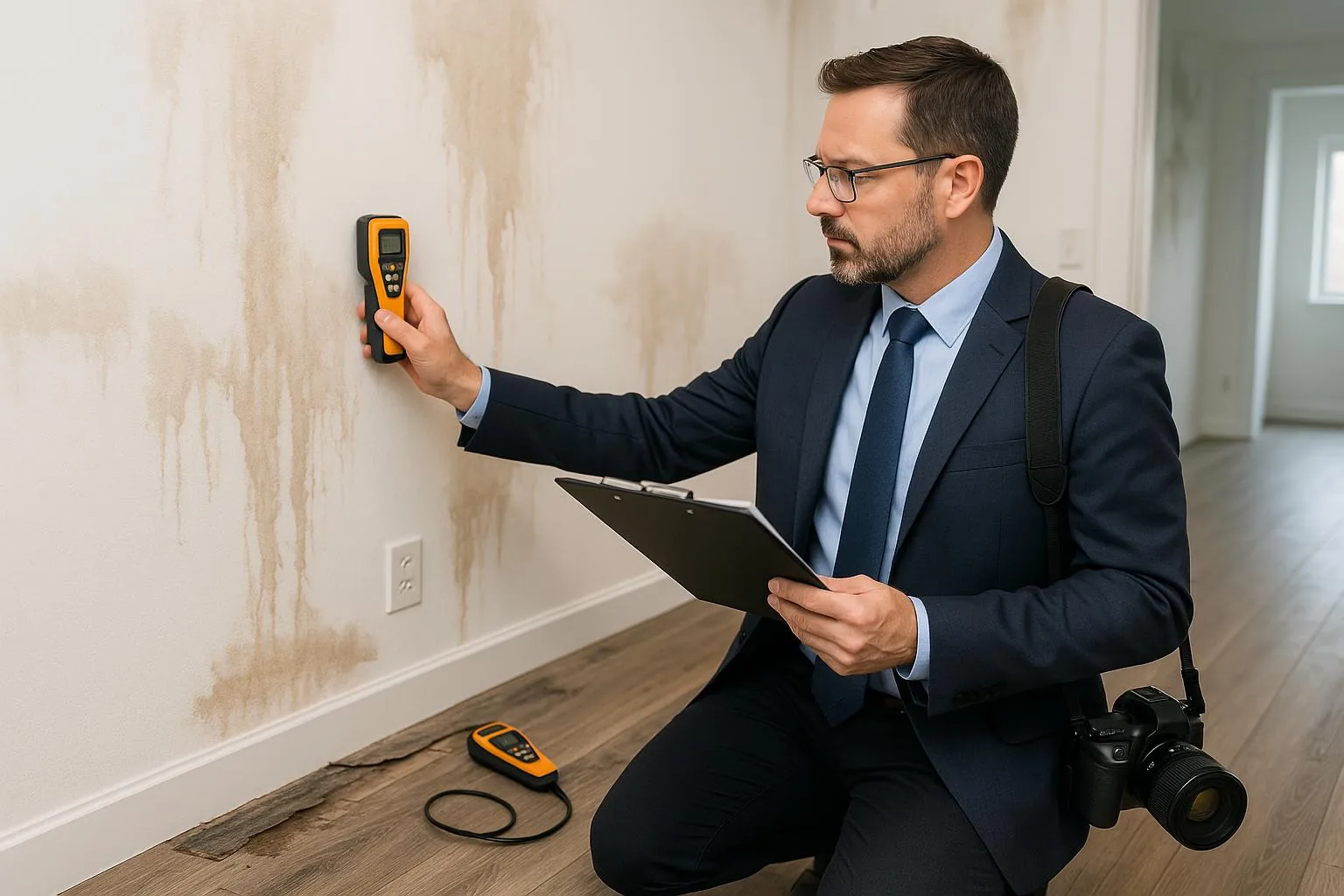
Insurance adjusters often scope water damage claims based on what is visible and dry at the time of inspection. We use moisture meters, thermal imaging, and professional drying documentation to establish the true extent of water migration and build a claim that reflects the full scope of damage.
Structural Water Damage: Saturated drywall, damaged insulation, warped framing, and compromised subfloor assemblies
Flooring Damage: Buckled hardwood, delaminated laminate, saturated carpet and pad, and damaged tile grout
Cabinet and Millwork Damage: Swollen cabinet boxes, warped doors, and damaged trim from prolonged moisture exposure
Appliance and Mechanical Damage: Water damage to HVAC equipment, water heaters, and electrical systems
Personal Property: Furniture, electronics, clothing, and valuables damaged by water or humidity
Mold Risk: Mold can begin growing within 24 to 48 hours of a water loss if moisture is not properly addressed
Houston, Texas
Water Damage Claims in Houston: Why So Many Get Underpaid
Water damage is the single most common Houston-area claim year-round — not just during hurricanes. Slab leaks, failed water heaters, HVAC condensation line blockages, supply line ruptures, and roof leaks all converge in a hot, humid environment that grows mold in days if mitigation is delayed. Carriers routinely underpay Houston water claims because they rely on the drying company's scope rather than an independent damage assessment, and they deny or reduce the mold component even when it is coverage-qualified.
Recent Houston-Area Events That Drive These Claims
HVAC Condensation Line Failures
Year-round
Houston's humidity means HVAC systems run hard and produce heavy condensation. A clogged or failed condensation line can flood an attic or ceiling cavity undetected for weeks. Carriers often classify this as "wear and tear" when the actual cause is a sudden and accidental event covered under the policy.
Supply Line Failures
Year-round
Under-sink and toilet supply lines are a leading cause of catastrophic residential water loss. A Conroe claim DCS handled from day one on a Liberty Mutual policy resulted in a settlement over $130,000 after the initial scope missed the full extent of subflooring and cabinet damage.
Winter Storm Uri Pipe Bursts
February 2021
Still generating supplementable claims today. Many Uri claims were closed before the full scope of wall-cavity damage was discovered during repairs.
Houston-Area Rules and Local Notes
Under Texas policy forms, water damage is typically covered when "sudden and accidental." The fight is almost always over whether the insurer can characterize the cause as "continuous or repeated seepage" (excluded) versus a single discrete event.
Mold coverage on Texas policies is normally a sub-limit endorsement (often $5,000–$25,000) unless your policy was specifically written with buy-back coverage. Fighting for the full mold sub-limit is routine; DCS documents mold cause, type, and remediation protocol per S520 standards.
Matching — when only part of a damaged floor, cabinet run, or wall is replaced and the replacement does not match existing finishes — is a major underpayment area. Texas has strong matching-statute support in TDI bulletins.
Houston-Area Case Results
Sheri — Friendswood, TX
Homeowners of America2024
HVAC condensation / concealed plumbing water damage
Initial
$10,000
→
Final
$250,000+
Sheri's Friendswood home suffered extensive concealed water damage from a failed HVAC condensation line. The initial Homeowners of America offer did not account for the full scope of subflooring, wall cavity, and cabinet damage. DCS documented the complete causation and damage trail and negotiated a 25× settlement increase.
Rick & Jeanne — Conroe, TX
Liberty Mutual2024
Toilet supply line failure
Initial
DCS engaged from day 1
→
Final
$130,000+
A failed toilet supply line caused extensive damage across multiple rooms. DCS was engaged from day one and presented a fully documented claim including subfloor, cabinet, and framing damage. Liberty Mutual settled for over $130,000.
JO
Reviewed by Josh Osteen
Founder & Licensed Public Adjuster
Josh Osteen founded Dependable Claims Specialists after seven years as an insurance carrier field adjuster and team lead (2010–2017). He has represented Houston-area policyholders exclusively since 2017 and has handled every major Gulf Coast catastrophe from Harvey through Hurricane Beryl.
Texas PA License #2237777Florida PA License #W045717
Know Your Peril
How Water Moves Through a Structure and Why It Matters for Your Claim
Water damage claims are frequently undervalued because adjusters assess visible damage rather than actual moisture migration. Understanding how water behaves in a structure helps explain why a professional moisture assessment is essential to a complete claim.
24-48 hrs
Mold Growth Window
Time before mold can begin in wet conditions
Up to 12 ft
Wall Cavity Travel
Distance water can wick through drywall paper
72+ hours
Subfloor Saturation
Time for subfloor to fully dry without equipment
Often 3x
Hidden Moisture
Hidden wet area vs. visible wet area ratio in typical claims
Water follows gravity and capillary action simultaneously. It flows downward through floor assemblies and upward through porous materials like drywall paper and wood framing via capillary wicking. A water loss on the second floor can saturate the ceiling of the first floor, travel down wall cavities, and reach the subfloor before the surface even appears wet.
Drywall is particularly vulnerable. The paper facing on drywall acts like a wick, drawing moisture laterally far beyond the point of initial contact. A wet area that appears to be 4 feet wide on the surface may have moisture extending 8 to 12 feet in each direction within the wall cavity.
The most common reason water damage claims are undervalued is that the insurance adjuster inspects the property after emergency drying has already begun, or after surfaces have dried on the outside while remaining wet inside. Moisture meters and thermal imaging cameras reveal what the eye cannot see, and we use both on every inspection.
What You Need to Know
Sudden and Accidental vs. Gradual Damage
Most homeowner policies cover sudden and accidental water damage, such as a burst pipe, but exclude gradual damage from a slow leak that has been occurring over time. The distinction matters enormously. Insurers sometimes classify damage as gradual to deny or limit coverage. We document the timeline of the loss and challenge misclassifications.
Category of Water Contamination
Water damage is classified by contamination level. Category 1 is clean water from a supply line. Category 2 (gray water) contains contaminants from appliances or sinks. Category 3 (black water) is highly contaminated water from sewage, flooding, or standing water. Higher category losses require more extensive remediation and cost more. We ensure the correct category is applied to your claim.
Drying Documentation and Your Claim
Professional water mitigation companies document the drying process with daily moisture readings. This documentation is essential to your claim because it establishes the extent of the damage and the cost of proper drying. We review mitigation invoices to ensure they are complete and that the insurance company pays for all covered drying costs.
Helpful Hints
Tips That Protect Your Claim
Document Before Drying Begins
Photograph all wet surfaces, water lines, and damaged materials before any drying equipment is placed. Once drying begins, the visible evidence of the extent of damage starts to disappear.
Do Not Discard Damaged Materials
Do not remove and discard wet drywall, flooring, or cabinets until the insurance adjuster has inspected. If emergency removal is necessary to prevent mold, photograph everything first and save samples.
Stop the Source First
Shut off the water supply to the affected area immediately. Your policy requires you to take reasonable steps to prevent further damage. Failure to do so can affect your claim.
Get Drying Documentation
Ask your water mitigation company for daily moisture logs and equipment placement records. This documentation supports your claim and establishes the true scope of the loss.
Report Promptly
Water damage claims have time-sensitive requirements. Report the claim to your insurer as soon as possible and contact us before the adjuster arrives.
Understand Your Coverage Source
Water damage from a burst pipe is typically covered by homeowner insurance. Water damage from surface flooding requires a separate flood policy. Off-premises municipal sewer or drainline backups may require a separate endorsement (whereas an on-premises clogged toilet overflow is typically covered standard). Know which coverage applies before you file.
Prevention
How to Reduce Your Risk
1
Know where your main water shutoff valve is located and make sure every adult in the household can operate it quickly in an emergency.
2
Install water leak detectors under sinks, near appliances, and around the water heater. Smart leak detectors can alert you by phone and automatically shut off the water supply.
3
Have your water heater inspected annually and replace it proactively before it fails. Most water heaters last 8 to 12 years.
4
Inspect washing machine hoses annually and replace rubber hoses with braided stainless steel hoses every 5 years.
5
Keep gutters clean and ensure downspouts direct water at least 6 feet away from the foundation.
6
Inspect your roof and attic annually for signs of leaks, especially after storms.
7
Have your plumbing inspected if your home is more than 30 years old. Older galvanized or polybutylene pipes are prone to failure.
8
Turn off the water supply to your home when you travel for more than a few days.
!
Critical: Protect Your Claim Before Starting Any Repairs
Do not begin full repairs until your claim is fully settled. Damage is evidence. Altering or removing it before your insurer has properly documented it can eliminate coverage entirely. Insurance companies only pay for what can be proven. Only perform emergency repairs necessary to prevent further damage, and document everything with photos and video before touching anything.
After the Loss
What to Do Right Now
1
Stop the Water Source
Shut off the water supply to the affected area or to the entire home if necessary. Every minute the water runs increases the damage.
2
Document Before Touching Anything
Photograph all wet surfaces, water lines on walls, and damaged materials. Take video as well. This documentation is the foundation of your claim.
3
Remove Standing Water Safely
If it is safe to do so, remove standing water with a wet vacuum or mop. Do not enter rooms with standing water if there is any risk of electrical hazard.
4
Call a Licensed Water Mitigation Company
Professional drying equipment is essential to prevent mold. Contact a licensed mitigation company and ask them to document the drying process with daily moisture readings.
5
Report the Claim to Your Insurer
Notify your insurance company promptly. Write down the claim number and adjuster name.
6
Contact DCS PIA Before the Adjuster Arrives
We will be present during the inspection to ensure the full scope of moisture migration is documented, not just the visible surface damage.
7
Do Not Accept a Settlement Without Review
Water damage claims are frequently undervalued. Never accept a final settlement without having it reviewed by a licensed public adjuster.
Why Representation Matters
Only a Fool Represents Themselves
Water damage claims seem straightforward but are among the most frequently disputed in residential insurance. The distinction between sudden and gradual damage, the extent of hidden moisture migration, the category of water contamination, and the cost of proper drying are all areas where the insurance company and the policyholder often disagree. Having a licensed public adjuster on your side advocates for these disputes to be resolved in your favor.
Adjusters who inspect after drying has begun often miss the true extent of moisture migration. We document before, during, and after drying.
Gradual damage exclusions are sometimes applied to losses that were actually sudden and accidental. We document the timeline and challenge incorrect exclusions.
Mold remediation costs are frequently excluded from initial estimates even when mold is a direct result of the covered water loss. We ensure mold costs are included when applicable.
Mitigation invoices are sometimes disputed or reduced by insurers. We review every line and advocate for payment of all covered drying and remediation costs.
Personal property damage from water is often undervalued. We document every affected item and ensure replacement cost or ACV is correctly applied.
The insurance company has a team of professionals working for them. You deserve one working for you.
We bring carrier-side experience, construction expertise, and genuine care to every claim.
We use professional moisture meters and thermal imaging on every water damage inspection to document hidden moisture that adjusters miss.
Our background in construction gives us a detailed understanding of how water migrates through different building assemblies and what it costs to properly restore them.
We work on contingency. No recovery means no fee.
We handle all communication with the insurer and the mitigation company to ensure your claim is properly supported.
We have handled water damage claims from burst pipes, appliance failures, roof leaks, and HVAC condensation across Texas and Florida.
Frequently Asked Questions
Generally yes, if the damage was sudden and accidental and you took reasonable steps to prevent it. However, if the insurer can show the pipe had been leaking gradually before the burst, they may attempt to apply a gradual damage exclusion. We document the cause and timeline to support your claim.
This is one of the most common disputes in water damage claims. We use moisture meters and thermal imaging to document the full extent of moisture migration and present that evidence to the insurer.
Gradual damage denials are frequently challenged successfully when the evidence supports a sudden cause. Contact us for a review of your denial.
It depends on the source of the water. Damage from a burst pipe or appliance failure is typically covered by homeowner insurance. Damage from surface flooding, storm surge, or rising groundwater requires a separate flood policy. We help you identify which coverage applies.
Mold can begin growing within 24 to 48 hours under the right conditions of moisture and temperature. This is why prompt drying is critical. If mold develops as a direct result of a covered water loss, the remediation cost is typically covered under your policy.
The information on this page is for general educational purposes only. Dependable Claims Specialists is a licensed public adjusting firm \u2014 not a law firm. Public adjusters help policyholders document, value, and negotiate property insurance claims; we do not practice law and we do not provide legal advice. For legal questions about your specific situation, including questions about coverage disputes, statute interpretation, or your legal rights, consult a licensed attorney in your state. Texas public adjusters operate under TX Ins. Code Chapter 4102; Florida public adjusters operate under FL Statute \u00a7626.854.
Ready to Get What Your Policy Owes You?
Schedule a free, no-obligation consultation with a licensed public adjuster today. No recovery, no percentage fee. Hiring a public adjuster is optional.